Categories
tfc Community

How to Cycle Sync for Your Best Exercise Routine

Why cycle syncing your workouts can help you feel stronger, recover better, and work with your hormones instead of against them.

Have you ever crushed a heavy lifting session one week, only to feel like the exact same workout was impossible the next? You’re not imagining it.

Many women notice predictable changes in their energy, strength, motivation, recovery, and even breathing throughout the month. While every woman experiences her menstrual cycle differently, the natural rise and fall of estrogen and progesterone can influence how your body responds to exercise.

That doesn’t mean your hormones are holding you back! In fact, understanding cycle syncing your workouts can help you make more informed training decisions, maximize performance when your body is primed for it, and give yourself extra grace when recovery deserves a little more attention.

Let’s take a closer look at what’s happening inside your body and how to use that information to your advantage.

Understanding the Four Phases of Your Menstrual Cycle

A typical menstrual cycle lasts about 28 days, although anything from 21–35 days is considered normal. Throughout the cycle, estrogen and progesterone fluctuate, influencing everything from your mood to your metabolism to your athletic performance.

Menstrual Phase

Approximate Days: 1–5

Hormone levels:

  • Estrogen: Low
  • Progesterone: Low

The menstrual phase begins on the first day of your period.

Because both primary reproductive hormones are at their lowest levels, some women experience fatigue, cramps, headaches, or lower motivation. Others feel surprisingly energized once menstruation begins, especially if premenstrual symptoms have resolved.

There isn’t one “correct” way to feel during your period.

If you’re feeling good, it’s perfectly safe to continue strength training. If your body is asking for a slower pace, this can also be an excellent time to prioritize walking, mobility work, lighter lifting, or recovery.

The key is listening to your body rather than forcing it to follow someone else’s schedule.

Follicular Phase

Approximate Days: 6–13

Hormone levels:

  • Estrogen: Rising
  • Progesterone: Low

The follicular phase starts during menstruation and continues until ovulation.

As estrogen steadily increases, many women begin noticing:

  • Improved energy
  • Better recovery
  • Increased motivation
  • Greater mental focus
  • Improved insulin sensitivity

This is often considered one of the best times for cycle syncing your workouts, particularly if your goals include building muscle or increasing strength.

Many women naturally feel more confident tackling heavier weights, learning new movement patterns, or increasing training intensity during this phase.

Ovulation

Approximate Days: 14–16

Hormone levels:

  • Estrogen: Peaks
  • Progesterone: Begins rising

Around ovulation, estrogen reaches its highest levels before progesterone starts to become the dominant hormone.

For many women, this is a peak performance window.

You may notice:

  • Greater strength
  • More explosive power
  • Higher confidence
  • Faster reaction times
  • Increased motivation

This can be an excellent time for:

  • Heavy compound lifts
  • Progressive overload
  • Sprint intervals
  • Plyometric exercises
  • Personal records (PRs)

If you’ve been thinking about attempting a new deadlift PR or adding more explosive movements to your routine, this may be when your body feels most prepared. (If you’re interested in safely incorporating jumping movements, check out my article on How to Safely Add Plyometrics for Women After 30.)

Some research also suggests ligament laxity may increase slightly around ovulation, so maintaining excellent lifting technique and avoiding careless movement becomes even more important.

Luteal Phase

Approximate Days: 17–28

Hormone levels:

  • Progesterone: High for much of the phase, then drops rapidly before menstruation
  • Estrogen: Moderate, then also declines before menstruation

After ovulation, progesterone becomes the dominant hormone.

Many women begin to notice subtle changes like:

  • Feeling warmer
  • Increased fatigue
  • More difficult recovery
  • Higher perceived effort during exercise
  • PMS symptoms

It’s important to remember that this phase doesn’t mean you should stop exercising. Instead, it may be a time to become more flexible with your expectations.

Hormone levels throughout the menstrual cycle with corresponding training recommendations.

What Do Estrogen and Progesterone Actually Do?

Understanding these two hormones makes it much easier to understand why your workouts may feel different throughout the month.

Estrogen

Estrogen does far more than regulate reproduction.

It also plays important roles in:

  • Supporting muscle repair
  • Improving insulin sensitivity
  • Promoting collagen production
  • Supporting bone health
  • Helping maintain connective tissue
  • Potentially improving recovery after exercise

As estrogen rises, many women naturally feel stronger, more energized, and more capable of handling higher training loads.

Progesterone

Progesterone prepares the body for a potential pregnancy after ovulation.

It also influences several systems that affect athletic performance, including:

  • Body temperature
  • Breathing patterns
  • Sleep quality
  • Mood
  • Recovery

Higher progesterone levels increase your resting body temperature, meaning workouts may simply feel harder even when you’re performing the same amount of work.

How Your Menstrual Cycle Can Affect Athletic Performance

Current research suggests that hormone fluctuations affect every woman differently. Some notice dramatic changes, while others experience very little variation.

However, several consistent patterns have emerged.

Follicular Phase: Your High-Performance Window

During the follicular phase, many women experience:

  • Greater strength
  • Better power output
  • Faster recovery
  • Higher motivation
  • Lower perceived effort

This is often the ideal time to:

  • Lift heavier weights
  • Increase training volume
  • Progress your workouts
  • Push for strength gains

If you’ve been working toward a new squat or deadlift goal, this may be when your body feels most prepared to tackle it.

Ovulation: Peak Power

Many athletes report their best performances around ovulation.

This can be an excellent opportunity to focus on:

  • Heavy lifting
  • Athletic performance
  • Speed work
  • Explosive movements
  • Challenging strength sessions

Again, quality movement remains important, especially during exercises requiring quick direction changes or jumping.

Luteal Phase: When Workouts May Feel Harder

The luteal phase isn’t “bad,” it simply asks your body to work a little differently.

Higher progesterone levels can increase ventilation, meaning many women naturally breathe more during exercise. This can create the sensation that cardio or high-intensity intervals are more difficult than usual.

As progesterone and estrogen rapidly decline in the days leading up to menstruation, some women also report:

  • Feeling unusually breathless
  • Increased anxiety
  • Higher perceived exertion
  • Reduced motivation

This doesn’t necessarily mean your fitness has declined. Your body is simply responding to changing hormone levels.

Other Hormonal Changes That Can Affect Your Workouts

Hormones influence much more than strength alone.

You may also notice:

Disrupted Sleep

Many women experience poorer sleep before their period, which can reduce recovery and make workouts feel more difficult.

Muscle Tightness and Tension

Some women notice increased stiffness, particularly in the hips, lower back, or shoulders.

Taking extra time for a thorough warm-up can make a noticeable difference.

Recovery Needs

During the late luteal phase, you may benefit from:

  • Extra sleep
  • More hydration
  • Adequate protein intake
  • Slightly reducing overall training volume

If you’ve read my guide on The Complete Guide to Hydration for Women, you’ll know that hormonal shifts can also influence your hydration needs; another reason to pay close attention to recovery during this phase.

A Simple Four-Week Guide to Cycle Syncing Your Workouts

Rather than treating your cycle as a strict schedule, think of it as a flexible roadmap.

Cycle PhaseTraining Focus
Week 1 (Menstrual)Recover as needed. Continue lifting if energy is good, or prioritize mobility, walking, and technique work.
Week 2 (Follicular)Increase intensity. Push progressive overload, heavier lifting, and strength-focused sessions.
Week 3 (Ovulation)Peak performance. Take advantage of feeling strong with heavier compound lifts, athletic movements, or PR attempts if you’re feeling your best.
Week 4 (Late Luteal)Shift toward recovery. Reduce overall training stress if needed, prioritize sleep, mobility, moderate loads, and quality movement.

Remember that this is only a guide.

Some women feel incredible during their luteal phase. Others experience significant fatigue during menstruation. Tracking your own cycle for several months can help you identify patterns unique to your body.

Listen to Your Body, Not Just Your Calendar

One of the biggest misconceptions about cycle syncing your workouts is that you should only exercise certain ways during specific phases.

That’s not the goal. Instead, cycle syncing is about giving yourself permission to adjust when your body needs it.

If you’re full of energy during your luteal phase, go lift heavy.

If your period leaves you exhausted, it’s okay to swap a hard workout for a walk!

The goal isn’t perfection. It’s consistency over time.

Learning to work with your hormones instead of constantly fighting them can help you enjoy your workouts more, recover more effectively, and build strength that lasts through every stage of life.

If you’re also interested in long-term strength and healthy aging, be sure to read How Functional Fitness Helps You Stay Strong for Life, where I dive into why building strength today pays dividends for decades to come.

Frequently Asked Questions

Should I stop lifting weights during my period?

Not unless you want to! Many women continue lifting throughout menstruation without any problems. Adjust your intensity based on how you feel rather than following a rigid rule.

Is the follicular phase really the best time to build strength?

Research suggests many women experience improved strength, recovery, and performance during the follicular phase due to rising estrogen levels. However, individual responses vary.

Why do I feel more out of breath before my period?

Higher progesterone levels during the luteal phase can increase ventilation, making exercise feel more challenging. Rapid hormonal changes before menstruation may also contribute to the sensation of breathlessness.

Does cycle syncing work for everyone?

No. Every woman responds differently to hormonal fluctuations. Cycle syncing is a helpful framework rather than a requirement, and should be adapted to your individual experience.

Final Thoughts

Your menstrual cycle isn’t something to “push through” or ignore. It’s valuable information that can help you make smarter training decisions.

Some weeks may be perfect for chasing new personal records. Other weeks may call for a little more recovery. Neither approach is better than the other…they’re simply different parts of a healthy, resilient training plan.

The strongest women aren’t the ones who never adapt. They’re the ones who know when to push, when to recover, and how to stay consistent through every season of life.

Ready to master your body’s hormonal transitions?

If you enjoyed this article, subscribe to The Fitness Cult newsletter for practical, science-backed guidance on women’s fitness, hormones, pregnancy, postpartum recovery, perimenopause, and lifelong strength. Every week, you’ll get expert tips to help you train smarter, feel stronger, and confidently navigate every stage of life.

Medical Disclaimer: This article is intended for educational purposes only and should not be considered medical advice. Hormonal responses vary from person to person. If you have irregular menstrual cycles, underlying medical conditions, or concerns about your hormones or exercise routine, consult your healthcare provider before making significant changes to your training.

join the tfc community!

subscribe to be best friends 🤍

Weekly wellness tips & mom support, straight to your inbox 💌

Categories
tfc Community

How Functional Fitness Helps You Stay Strong for Life

When many of us think about fitness, we start with focusing on short-term goals. Maybe it’s fitting into a favorite pair of jeans, losing weight before a vacation, or getting back into a workout routine after having a baby. While there is nothing wrong with those goals, functional fitness encourages us to think bigger.

Instead of viewing exercise as a temporary project or a punishment for what we’ve eaten, it helps us build a lifelong relationship with movement. The goal is not simply to look a certain way today, but to stay strong, capable, confident, and independent for years to come.

Whether you’re navigating pregnancy, recovering postpartum, chasing toddlers, managing the changes of perimenopause, or looking ahead to healthy aging, functional fitness can help you create a foundation that supports every season of life.

What is Functional Fitness?

Defining Functional Fitness

Functional fitness refers to exercises that train your body for real-life movement. Rather than isolating a single muscle group, functional exercises often involve multiple joints and muscle groups working together.

Functional fitness compared to traditional fitness goals

Examples of real-life functional movements include:

  • Squatting to pick up a child
  • Carrying groceries
  • Pushing a stroller or cart
  • Climbing stairs
  • Lifting laundry baskets
  • Getting up and down from the floor

The common movement patterns in functional fitness include bending, hinging, pushing, pulling, carrying, rotating, and balancing. The purpose is simple: train for life, not just the gym.

Why Functional Fitness Looks Different for Every Woman

One of the best things about functional fitness is that it can be adapted to your current stage of life.

A postpartum mom may focus on rebuilding core strength and pelvic floor function. A woman in perimenopause may prioritize preserving muscle mass and bone density. An active retiree may focus on balance and fall prevention.

The common thread is learning to move well so everyday activities feel easier and more enjoyable.

Understanding Longevity

Key pillars that support functional longevity

Longevity is About More Than Living Longer

When people hear the word “longevity,” they often think about lifespan. However, longevity is not only about the number of years you live. It’s also, maybe even more importantly, about the quality of those years.

Can you travel comfortably? Are you able to get down on the floor and play with your kids, your grandkids, your dog? Do you carry your own luggage, groceries, and laundry?

Most importantly, can you continue enjoying the hobbies and activities that you love? These are the questions that matter, and their answers are what really represent longevity.

Independence is One of the Greatest Health Goals

Many women never think about maintaining their independence until they notice it beginning to decline. The reality is that every workout, every walk, and every strength-training session is an investment in your future self.

The strength you build today may help you for years in the future with things like:

  • Navigating stairs with confidence
  • Maintaining mobility pain-free later in life
  • Reducing fall risk
  • Continuing to participate in activities you enjoy
  • Preserving independence as you age

This long-term mindset is one of the most powerful benefits of functional fitness.

How Functional Fitness Supports Overall Health and Wellness

Functional Fitness Supports Heart and Metabolic Health

While strength training often gets the spotlight, functional fitness supports cardiovascular and metabolic health as well.

Regular movement can help:

  • Improve blood sugar regulation (reducing risk of type 2 diabetes)
  • Support heart health
  • Increase energy levels
  • Improve endurance
  • Enhance overall physical function

This is one reason why fitness doesn’t need to be extreme to be effective. Consistent movement often produces greater long-term results than short bursts of unsustainable effort.

Functional Fitness Helps Manage Stress

Major life transitions can place significant demands on both physical and mental health. New motherhood, hormonal fluctuations, career responsibilities, caregiving, and aging can all increase stress levels.

Regular exercise has been shown to support mood, reduce stress, and improve overall well-being. Even a short walk, mobility session, or strength workout can provide meaningful benefits.

This idea will become important later when we discuss building movement into everyday life rather than relying solely on structured workouts.

Functional Fitness and Joint Health

Strong Muscles Help Protect Your Joints

Your muscles act like a support system for your joints.

When muscles surrounding the knees, hips, shoulders, and spine are strong, they help distribute force more efficiently. This can improve movement mechanics and reduce unnecessary stress on joints.

Movement Helps Keep Joints Healthy

Movement increases circulation and helps nourish joint structures.

Regular exercise can help maintain:

  • Joint mobility
  • Range of motion
  • Stability
  • Movement confidence

Many women assume they should stop moving when joints become stiff. In many cases, appropriate movement is part of the solution.

For women experiencing menopause-related joint discomfort, you may also enjoy reading Menopause and Joint Pain: The Estrogen Connection.

Functional Fitness and Bone Health

Why Strength Training Matters for Bone Density

Bone is living tissue that responds to stress.

Resistance training and weight-bearing activities stimulate bone remodeling and can help maintain or improve bone density over time.

This becomes especially important during:

  • Postpartum recovery
  • Perimenopause
  • Menopause
  • Later adulthood

Women naturally experience hormonal changes that can impact bone health. Strength training provides an important tool for protecting the skeletal system.

For a deeper dive, check out Lifting Heavy for Women: Strong Bones at Any Age.

Functional fitness benefits through different stages of life

Building a Strong Foundation for Future Decades

When we think about functional fitness, we’re often focused on today’s workout.

However, each strength-training session is also helping support the body you’ll have years from now.

The habits you build today can help preserve mobility, confidence, and independence well into later life.

Functional Fitness and Chronic Pain Management

Movement Can Be Part of the Solution

Many people living with chronic pain become fearful of movement.

While every situation is unique and should be evaluated by a qualified healthcare professional, research increasingly shows that appropriately prescribed exercise can play an important role in chronic pain management.

Movement may help:

  • Improve strength
  • Increase mobility
  • Enhance physical function
  • Improve confidence in movement

Building Strength Around Vulnerable Areas

Functional fitness focuses on movement quality rather than simply pushing harder.

As muscles become stronger and movement patterns improve, many women find daily activities become more manageable.

Again, the goal is not perfection. The goal is creating a body that feels capable and supported.

Functional Fitness Improves Ease of Movement

Everyday Tasks Become Easier

One of the most rewarding benefits of functional fitness is that improvements show up in everyday life.

You may notice:

  • Carrying a child feels easier
  • Household chores require less effort
  • Yard work feels more manageable
  • Standing from the floor becomes easier
  • Recreational activities feel more enjoyable

Fitness That Transfers Into Real Life

This is where functional fitness shines.

Instead of measuring success only by a number on a scale, you begin measuring success by what your body can do.

That shift often creates a healthier and more sustainable relationship with exercise.

Functional Fitness Improves Balance, Coordination, and Proprioception

What Is Proprioception?

Proprioception is your body’s ability to sense where it is in space.

It helps you:

  • Maintain balance
  • Adjust to uneven surfaces
  • Coordinate movement
  • React quickly to changes in your environment

Why Balance Training Matters

Balance naturally declines with age if it is not practiced.

Fortunately, balance can be trained.

Single-leg exercises, carries, step-ups, and mobility work all challenge balance while building confidence and stability.

Coordination Helps Us Move More Efficiently

Life rarely requires movement in a perfectly controlled environment.

Functional fitness teaches your body to work as a coordinated system, helping improve reaction time, body awareness, and movement efficiency.

How to Incorporate Functional Fitness Into Everyday Life

Focus on Fundamental Movement Patterns

You do not need fancy equipment to begin practicing functional fitness.

Include movements such as:

  • Squats
  • Hinges
  • Pushes
  • Pulls
  • Carries
  • Rotational exercises

These patterns mirror many daily activities.

Look for Opportunities Throughout the Day

Some of the most effective movement habits don’t happen in a gym.

Try:

  • Taking the stairs
  • Walking during phone calls
  • Carrying groceries instead of using a cart
  • Playing actively with your children
  • Walking the dog
  • Gardening
  • Parking farther away

These small choices help reinforce the idea that movement is part of life rather than something separate from it.

Consistency Beats Perfection

One of the biggest lessons functional fitness teaches is that consistency matters more than perfection.

A sustainable routine performed for years will always outperform an extreme routine that lasts only a few weeks.

A Sample Functional Fitness Weekly Calendar

Weekly functional fitness schedule for longevity

Monday

Upper Body Functional Strength

  • Rows
  • Push-ups
  • Overhead presses
  • Farmer carries

Tuesday

Natural Cardio

  • Walk the dog
  • Family walk
  • Leisure bike ride

Wednesday

Lower Body Functional Strength

  • Squats
  • Deadlifts
  • Step-ups
  • Lunges

Thursday

Active Recovery

  • Yoga
  • Mobility work
  • Foam rolling
  • Stretching

Friday

Total Body Functional Strength

  • Squat-to-press
  • Carries
  • Rows
  • Core work

Saturday

Fun Movement Day

  • Hiking
  • Swimming
  • Pickleball
  • Dancing
  • Playing with the kids

Sunday

Recovery Walk and Mobility

This approach provides a realistic balance of strength, cardiovascular exercise, recovery, and everyday movement.

Start Building Strength for Life

The beauty of functional fitness is that it doesn’t require perfection.

Fitness as a lifelong relationship supporting healthy aging

You don’t need to spend hours in the gym or chase every trend. And you don’t need to wait for the perfect season of life.

Instead, you can start with simple, sustainable actions that help you move better today while investing in your future health.

Every walk, every strength-training session, and every mobility workout is a deposit into the future version of yourself.

If you’re ready to stop starting over and begin building a routine that fits real life, explore the 6-Week Reset Button Program. It’s designed to help busy women create sustainable habits, build strength, improve energy, and make movement a natural part of everyday life.

Because the goal isn’t just exercising today.

The goal is staying strong for life.

join the tfc community!

subscribe to be best friends 🤍

Weekly wellness tips & mom support, straight to your inbox 💌


References

  1. Zhao R, Zhao M, Xu Z. The effects of different resistance training modes on bone mineral density in postmenopausal women: a meta-analysis.
  2. Shnayderman I, Katz-Leurer M. An aerobic walking programme versus muscle strengthening programme for chronic low back pain.
  3. Sherrington C, Fairhall N, Wallbank G, et al. Exercise for preventing falls in older people living in the community.
  4. Fragala MS, Cadore EL, Dorgo S, et al. Resistance training for older adults: position statement from the National Strength and Conditioning Association.
  5. World Health Organization. Physical Activity Guidelines and Healthy Ageing.
Categories
tfc Community

Summer Travel Fitness Tips for Staying Strong and Mobile

Summer is meant for memory making, slower mornings, family trips, beach days, and long weekends away. However, for many of us, travel season can also bring swollen ankles, stiff hips, achy backs, disrupted routines, and the feeling that all progress disappears the second vacation starts. The good news is that summer travel fitness does not have to mean squeezing intense workouts into a packed itinerary, or compromising your relaxation for a structured gym session. In fact, the women who stay strongest and feel best during travel season are usually the ones who focus on consistency, movement, and honoring their recovery rather than perfection.

Whether you are navigating pregnancy or postpartum recovery, juggling kids during vacation, or managing the changes that come with perimenopause and menopause, your body responds well to regular movement and supportive habits. Even small choices throughout the day can help you stay mobile, energized, and pain-free while traveling.

Why Summer Travel Fitness Can Feel Harder Than Expected

Travel often creates the perfect storm for stiffness and fatigue. Long hours in a car or airplane reduce circulation and leave muscles feeling tight. Sleep schedules change, jet lag disrupts your sleep quality, and hotel beds and pillows are not always as comfortable as the ones you left back home. Hydration drops and meals become less structured. Suddenly, your body feels completely different after only a few days away from home.

For postpartum women, travel can increase pelvic floor pressure, hip tightness, and low back discomfort. Meanwhile, women in perimenopause may notice more joint stiffness, swelling, or slower recovery during long travel days due to the effects of hormonal changes on muscle tissues.

On top of it all, it is too easy to fall into an “all or nothing” mindset with summer travel fitness. If you cannot complete your usual workout routine, you may stop moving altogether, and return home feeling discouraged, inflamed, and exhausted.

Instead, think about movement as support for your vacation experience. The goal is not to train harder; the goal is to feel better while fully enjoying your summer.

Start with Movement Snacks

One of the easiest ways to stay consistent during travel season is by using movement snacks.

Movement snacks are short bursts of activity that help your body reset throughout the day. Most only take a few minutes, but they can dramatically improve circulation, mobility, posture, and energy levels.

Instead of waiting for the “perfect”time to work out, movement snacks allow summer travel fitness to fit naturally into your day.

Easy movement snacks for staying active during summer travel fitness

Some simple examples include:

  • Walking the airport terminal before boarding
  • Doing bodyweight squats at a rest stop
  • Stretching your hips before bed
  • Walking while your kids play outside
  • Climbing hotel stairs
  • Using resistance bands for quick upper body activation

Even five minutes of movement can reduce stiffness after sitting for long periods.

This is especially important during travel because prolonged sitting can leave the glutes under active and the hips locked up. That combination often contributes to lower back discomfort and poor posture. If you want to better understand how strength supports pain prevention, check out The Truth About Metabolism for Women: Muscle vs Cardio, where I explain why maintaining muscle matters so much for long term health and mobility.

Summer Travel Fitness As Fun Rather Than Structured

One of the biggest mindset shifts for summer travel fitness is realizing that movement does not always have to look like structured exercise.

Vacation is actually a perfect time to move more naturally! Instead of being stuck in traffic during commutes or sitting at a desk during the workday, you have the freedom to move about and explore new places.

Instead of forcing yourself through exhausting workouts when you are supposed to be enjoying a relaxing vacation, look for activities that can keep you moving and also make your trip more enjoyable!

A few great options include:

Fun ways to stay active during summer travel
  • Morning beach walks
  • Hiking local trails
  • Walking to get breakfast or coffee
  • Swimming with your kids
  • Paddle boarding or kayaking
  • Exploring a city by bike
  • Playing pickleball or volleyball
  • Resort yoga classes
  • Evening walks after dinner

These activities support circulation, mobility, heart health, and mental wellness without adding stress to your schedule.

Additionally, leisure movement helps regulate stress hormones and blood sugar levels, which can be especially helpful during times of hormonal transition, like postpartum or perimenopause. Gentle movement also lubricates joints and improves energy levels after long travel days.

If you are traveling with family, this is a great opportunity to build movement into your memories together. Fun and Engaging Family Activities to Encourage Movement offers even more ideas for staying active without making fitness feel like a chore.

Summer Travel Fitness Essentials to Prevent Pain

You do not need an entire gym setup to support your body during vacation. All you really need is yourself, but having a few small tools can make a huge difference in how you feel.

A Tennis Ball: Your New Favorite Tool

A tennis ball takes up almost no space in your bag, yet it can provide incredible relief after long travel days. And if you really want to avoid packing one, many resorts that offer sports will already have tennis balls on-site.

Summer travel fitness essentials for staying strong and pain-free

Using a tennis ball for self myofascial release (SMR), or “foam rolling,” can help loosen tight muscles in the:

  • Glutes
  • Feet
  • Upper back
  • Shoulders
  • Calves

After sitting in a car or airplane for hours, gently rolling these areas can improve circulation and reduce tension before bed.

The glutes especially tend to tighten during long periods of sitting. When they stop working efficiently, the lower back often compensates. Spending even a few minutes releasing those muscles can help your body feel dramatically better the next morning.

Resistance Bands to Make Summer Travel Fitness Easier

Resistance bands are another travel essential because they are lightweight, portable, and surprisingly effective.

Closed loop bands work well for lower body activation and glute work. Meanwhile, bands with handles are great for rows, presses and upper body exercises. If you are planning a longer vacation or trip, resistance bands allow you to maintain strength without needing access to a gym.

If you are short on time, quick workouts can still be incredibly effective. 15-Minute Functional HIIT Workout for When You’re Short on Time is a great option when you want structured guidance without spending an hour exercising.

A Simple Summer Travel Fitness Plan You Can Actually Follow

The best summer travel fitness routine is usually the simplest one. Instead of trying to maintain your full home schedule, focus on realistic habits that support your energy, strength, and mobility.

Here is a practical framework you can follow during travel season:

1 to 3 Short Strength Workouts Each Week

Hotel room resistance band workout for summer travel fitness

Aim for about 10 minutes at a time. Resistance bands, bodyweight exercises, or simple hotel room circuits are enough to maintain your consistency while traveling.

Daily Walking

Walking helps circulation, digestion, mobility, and recovery. It is also one of the easiest ways to stay active while traveling.

Mobility Before Bed

Five minutes of stretching or gentle mobility work before sleep can reduce stiffness and help your body recover from long days.

One Fun Activity Each Day

Choose movement that feels enjoyable instead of forced. Swimming, hiking, biking, and paddle boarding all count toward summer travel fitness.

Summer Travel Fitness is About Staying Consistent, Not Perfect

Many women believe they have “fallen off track” after missing workouts during vacation. However, fitness is not ruined by a single trip, a busy week, or a disrupted routine.

In reality, sustainable fitness comes from learning how to adapt to real life. That means walking still counts, mobility still counts, short workouts still count, and recovery still counts.

This mindset is especially important for moms and women navigating hormonal transitions because stress and burnout often create bigger setbacks than reduced workout volume. In other words, the break and reset from vacation is worth the small routine disruption for your overall wellness!

If you struggle with motivation when routines change, How to Stay Motivated When You Don’t Feel Like Working Out can help you build a more flexible and sustainable approach to consistency.

Similarly, How to Balance Exercise and Rest to Avoid Burnout and Support Long Term Fitness dives deeper into finding the right balance between movement and recovery for your long term wellness.

Final Thoughts

Your body was never designed to thrive through constant restriction, guilt, or perfectionism. Summer travel fitness should support your life, not compete with it.

When you prioritize movement snacks, simple strength work, mobility, hydration, and fun activities, you can return home feeling energized instead of depleted. You do not need perfect workouts to stay strong and mobile during travel season. You simply need supportive habits that fit your real life!

If you want extra accountability this summer, my 6 Week Reset Program is designed to help women stay consistent with realistic, follow-along workouts that can be done from home, from a hotel room, or while balancing a busy schedule. The workouts are simple, effective, and built for real-life seasons so you can stay on track without guilt or overwhelm.

Because strong, healthy movement should travel with you wherever life takes you!

join the tfc community!

subscribe to be best friends 🤍

Weekly wellness tips & mom support, straight to your inbox 💌

Categories
tfc Community

How to Set Realistic New Year Fitness Goals When You’re Short on Time

Every January, the motivation is there! The calendar is fresh and the intentions are good.

And yet, for so many people, New Year fitness goals start to unravel before February even hits.

It’s not because you lack willpower or discipline, but because most fitness goals are built for an ideal life, not a real (read: busy) life!

Between work, family responsibilities, mental load, and everything else life throws your way, fitness often just feels like one more thing competing for your limited time and energy.

The good news is that you don’t need more hours in the day to make progress; you just need a smarter, more realistic approach!

This guide will help you set New Year fitness goals that actually fit into a busy lifestyle and stick long after the January motivation fades.

Why Most New Year Fitness Goals Fail

Many New Year fitness goals are rooted in extremes. Five workouts a week, perfect nutrition, no missed days…and no flexibility.

That all-or-nothing mindset might feel motivating at first, but it rarely survives real life. One missed workout turns into guilt. Guilt turns into avoidance, and suddenly, the entire plan feels like a failure.

For busy adults, especially parents or caregivers, this approach simply isn’t sustainable. Schedules change, sleep is inconsistent, energy fluctuates and life happens.

The key to success lies with shifting the focus from intensity and perfection to consistency and sustainability.

What “Realistic” Fitness Goals Actually Mean

Realistic doesn’t mean easy or ineffective, it means aligned with your actual lifestyle.

A realistic fitness goal:

  • Accounts for limited time
  • Allows flexibility
  • Prioritizes long term progress over short term extremes
  • Can be maintained during busy or stressful seasons

For example, committing to two or three intentional workouts per week is far more effective than planning five workouts you can’t consistently complete. Consistency builds momentum, and momentum builds results.

This mindset is especially important for parents juggling childcare, work demands, or unpredictable routines, but it applies to anyone with a full plate.

Use SMART Goals Without Overcomplicating Them

Structure matters, but it shouldn’t feel overwhelming. Using SMART goals helps turn vague intentions into clear, actionable plans.

SMART Goals are:

  • Specific
  • Measurable
  • Achievable
  • Relevant
  • Time-bound

Instead of saying, “I want to get in shape,” a SMART Goal might sound like, “I will complete two 20-minute strength workouts per week for the next eight weeks.”

If you want a deeper breakdown, you can revisit the full explanation in this post on SMART Goal setting and how to apply it to fitness goals.

The goal isn’t to make fitness rigid; it’s to give yourself a clear direction that still allows flexibility.

Make Small, Intentional Changes That Add Up

One of the biggest mistakes people make is assuming progress requires massive changes. In reality, small, intentional shifts are far more powerful.

Examples of realistic changes:

  • Choosing 15 to 20 minute workouts instead of an hour
  • Adding daily walks, even broken into shorter chuhnks
  • Strength training twice per week instead of daily cardio
  • Moving more throughout the day instead of relying on one long session

These changes feel manageable, which makes them repeatable. And repeatable habits are what create lasting results!

If you’re balancing work and family life, ideas like family-friendly workouts or strategies from this post on fitting fitness into a busy mom schedule can help you stay active without adding stress.

Let Go of Perfectionism and the All or Nothing Trap

Perfectionism is one of the biggest barriers to consistency.

Missing a workout doesn’t mean you failed, it means you’re human. Life ebbs and flows, and your fitness routine should be able to ebb and flow and with it!

This is especially important during major life transitions like pregnancy, postpartum recovery, or high stress seasons at work. Adjusting your goals does not mean giving up, it means adapting.

If you’re navigating pregnancy or postpartum fitness, this post on setting realistic goals during pregnancy offers a supportive, realistic framework for staying active without pressure.

Showing up imperfectly still counts.

Build a Plan That Matches Your Actual Lifestyle

The most effective fitness plan is the one that removes barriers, not adds them.

If getting to the gym feels like a logistical nightmare, home workouts may be the better option. If time is your biggest constraint, shorter sessions done consistently will outperform sporadic long workouts.

Creating a simple, accessible setup can make a huge difference! This guide to building a home gym for under $500 breaks down how to create a functional space without overcomplicating thongs or overspending.

When fitness fits into your life instead of fighting it, consistency becomes much easier!

Motivation Comes and Goes. Systems Matter More!

Motivation is unreliable; some days you’ll feel excited to workout! Other days, you may not, which is fine and normal.

Son, instead of relying on motivation, focus on systems:

  • Scheduling workouts like appointments
  • Choosing workouts you enjoy
  • Having workouts planned to reduce decision fatigue
  • Allowing rest days without guilt

Understanding how to stay motivated when you don’t feel like working out and how to balance exercise and rest can you help you build a routine that supports both physical and mental health.

Rest is not a setback, it’s an important part of the process.

Join the Fitty 500 for Built-In Consistency

If your goal is to stay consistent without pressure, the Fitty 500 is for you! I designed the Fitty 500 Challenge with busy lives in mind.

A green t-shirt with the text 'Fitty 500' laid out on a wooden floor next to a gold medal and a pair of running shoes, with a bright, cozy room in the background.

The Fitty 500 is a year-long movement challenge where you can walk, run, or hike your way to 500 miles at your own pace. It’s flexible, accessible, and focused on long-term consistency rather than perfection.

Registration is currently open, with early bird pricing available through 01/15 before the price increases to the regular registration fee. If you want accountability without rigidity, this is a powerful way to stay committed throughout the year.

Simplify Your Fitness With Ready-Made Programs

If decision fatigue is holding you back, following a structured program can make consistency easier.

You can browse all available programs to find the right fit for your goals and schedule. If your focus is body recomposition, the 6-Week Reset Button is designed to help you build muscle while you burn fat with efficient, realistic workouts that fit into busy routines. I created it specifically with a New Year refresh and recommittment to a fitness routine in mind and provide strength workouts you can do anywhere, a weekly calendar to follow along, nutrition guidance and high-protein recipes, and progress trackers to help you stay accountable and measure your results!

Less guesswork = more progress.

You Don’t Need More Time (When You Have a Better Plan!)

Setting realistic New Year fitness goals doesn’t mean lowering your standards, it means choosing an approach you can sustain.

Start small and stay flexible. Change your focus to consistency over perfection.

And, if you want personalized support to build a plan that truly fits your life, you can book a free consultation to get guidance tailored to your goals, schedule, and current season of life.

I’m an ACE Certified Personal Trainer and Fitness Nutrition Specialist, a NASM Women’s Fitness Specialist with an emphasis on pre-/postnatal fitness, and a busy new mom! And I would be honored to be able to be part of your fitness journey in 2026.

This year doesn’t need to be about extremes. It can be about progress that actually lasts!

join the tfc community!

subscribe to be best friends 🤍

Weekly wellness tips & mom support, straight to your inbox 💌

Categories
Recovery & Wellness tfc Community

New Year Fitness Reset: How to Honor Your Progress and Start Fresh

The start of a new year has a way of making us feel like we need to erase everything and start over. New goals, new routines, new versions of ourselves.

But here’s the truth most fitness conversations miss: you don’t need a clean slate! You already have momentum, experience, and growth behind you (yes, even if the last few weeks of the year didn’t look how you planned!).

This New Year fitness reset isn’t about guilt or perfection, it’s about honoring what you have already accomplished and choosing how you want to move forward now.

Celebrate the Small Wins (They Matter More Than You Think!)

Progress isn’t only measured in before and after photos or perfect streaks of workouts. Some of the most important wins are the quiet ones.

Maybe you move your body during seasons when motivation was low; that’s a win! Maybe your workouts became shorter, but more consistent; that’s a win! Maybe you chose walks, mobility, or rest when your body asked for it; that’s a win!

For moms especially, fitness often happens in fragments; a stroller walk or a home workout squeezed in during nap time. A season of showing up imperfectly but repeatedly.

Those moments count! They build resilience, confidence, and a foundation you can continue to build on.

So, before you rush into the next goal, take a moment to acknowledge all you have accomplished this year!

Falling Off the Wagon Doesn’t Erase Your Progress

The holidays, illness, travel, or burnout can easily disrupt routines, but that doesn’t mean you’ve failed.

Fitness isn’t fragile! A few weeks off doesn’t undo months of consistency; your body remembers the habits you’ve built, and your mind remembers what movement feels like.

You didn’t quit, you paused.

And pauses are part of a sustainable, lifelong approach to health and wellness!

Let this be your permission slip to let yourself off the hook and stop letting the end of the year (a time when most of us are slowing down and enjoying time with family) overshadow everything you’ve worked for in the months before!

2025, My First Postpartum Year: A Different Kind of Strength

This past year was my first year postpartum after welcoming my first baby at the end of 2024, and it challenged me in ways I did not fully anticipate.

I struggled with pelvic floor dysfunction, especially when running, and I navigated postpartum depression and anxiety. My workouts looked nothing like they did before pregnancy, and mentally, I had to relearn how to meet myself where I was.

What made the biggest difference was community: leaning on other moms and parents for support, honesty, and relatability reminded me that I wasn’t broken, I was rebuilding.

That experience is why I created Core & Restore: No-Leak Physique, to help women rebuild core and pelvic floor strength with confidence. It’s also why I created Run Like A Mother: The Postpartum Comeback, to support moms returning to (or starting for the first time!) running safely and sustainably.

My challenges became the blueprint for helping other women move forward without fear or frustration.

Starting Fresh Without Starting Over

Prioritize Yourself and Your Health

Taking care of your body isn’t selfish; it’s foundational.

When you prioritize your health, you show up with more energy, patience, and resilience, not just for yourself, but for everyone who depends on you as well.

This year, let your wellness matter.

Incorporate Fitness in a Realistic Way

A successful New Year fitness plan fits into real life.

That might mean fewer workouts with more intention, choosing movement you actually enjoy, or letting walking count. Let your season set the pace!

Consistency doesn’t require intensity, it requires sustainability.

The Fitty 500: A New Year Fitness Challenge Built for Real Life

One of my biggest personal milestones this year was running 500 miles in 2025. This was the most mileage I’ve ever covered in a single year, and doing it during my first year postpartum felt intimidating. But I chose this goal intentionally.

I wanted a reason to keep moving for me and for my daughter: for my physical and mental health, to show up for myself, and to model for her that women are strong, capable, and resilient.

I also knew that my workouts would look different with a new baby. Relying on walking, jogging, and running felt realistic and flexible. It became something I could do with my daughter alongside me, rather than something that pulled me away from her.

That experience, and the joy and accomplishment I felt when I completed my goal with 10 days to spare, is what inspired the Fitty 500.

The Fitty 500 is a virtual fitness challenge to run, walk, or hike 500 miles throughout 2026, at your own pace. It’s designed for all fitness levels and busy lives.

You’ll get:

  • A full year to complete the challenge
  • Access to a supportive Strava community and mileage tracker
  • Accountabiltity without pressure or guilt
  • A Finisher’s Prize (including a custom medal and t-shirt) when you complete all 500 miles

Early bird registration is $43 now through 01/15, then it increases to $57.

If you’re looking for motivation that lasts beyond January, this is it!

More Ways to Move Forward With Support

If you’re craving structure, guidance, or a plan that fits in your current season:

You don’t have to figure this out alone!

Carry Your Progress Into the New Year

You don’t need to become a new person in January, you just need to keep going.

Take your wins with you! Let go of guilt, and choose goals that support your life, not compete with it.

This year, let fitness be something that strengthens you, not something that weighs you down. You’ve got this!

join the tfc community!

subscribe to be best friends 🤍

Weekly wellness tips & mom support, straight to your inbox 💌

Categories
tfc Community

How to Stay Consistent in 2026: The “Fitty 500” Mileage Challenge

Let’s be honest: New Year’s resolutions are kind of a scam.

Every January, we’re bombarded with “New Year, New You” ads that suggest we need to spend two hours at the gym or eat nothing but kale to be “fit.” As a certified personal trainer and a new mom, I’m calling bologna sandwiches on that!

Fitness shouldn’t be a punishment for what you ate, and it shouldn’t feel like a second job. It should be functional, achievable, and, dare I say it, fun.

That’s why I’m launching the Fitty 500!

What is the Fitty 500?

The Fitty 500 is a year-long virtual mileage challenge to walk, run, or hike 500 combined miles in 2026.

Before you gasp and close this tab…500 miles sounds like a trek across the country, but the math is actually beautifully simple. It’s 1.3 miles a day. That is a 25-minute stroll with the stroller, a quick jog before the house wakes up, or a few extra laps around the park while the kids play.

A Challenge for the “Rest of Us”

I’ve seen those challenges to run 2,026 miles in a year. They’re amazing! But for a lot of us (especially those of us balancing careers, motherhood, and the general chaos of life) that can feel impossible and just like a recipe for burnout.

I wanted something that promoted consistency over intensity. 500 miles is the “Goldilocks” of goals. It’s enough to improve your heart health and clear your head, but realistic enough that a week of the flu won’t ruin your progress.

The “Bling” at the Finish Line

A dark green T-shirt with 'I Crushed the Fitty 500' printed on it, a gold finisher's medal beside it, and a pair of white athletic shoes on a wooden floor in a bright living room.

Because we all love a little “participation trophy” energy, I’m making the finisher’s package extra special. When you hit your 500th mile, you don’t just get a pat on the back. You get:

  • 🏅 A custom, heavy-duty Finisher’s Medal.
  • 👕 An ultra-soft, limited-edition “I Crushed the Fitty 500” T-shirt.
  • ✨ A branded Fitness Cult sticker for your water bottle or laptop.

How to Join the “Cult” (The Good Kind!)

Registration is officially OPEN! If you sign up before January 15th, you can snag the Early Bird pricing of just $43 (regularly $57).

Your registration includes:

  1. Instant Access: My Fitty 500 Training Guide with warm-ups, cool-downs, and injury-prevention tips.
  2. Tracking: Join our private Strava club to see your progress and cheer on others.
  3. The Prize: Your shirt and medal sent right to your door once you finish!

Ready to lace up?

Whether you want to follow a Couch to 5K program or just want an excuse to get outside more often, I’d love to have you. Let’s make 2026 the year we stop punishing our bodies and start moving them because we can.

join the tfc community!

subscribe to be best friends 🤍

Weekly wellness tips & mom support, straight to your inbox 💌

Categories
tfc Community

Free Mommy & Me Event!

January 19th, 2026
February 13th, 2026
March 17th, 2026
Categories
Prenatal Fitness tfc Community

Fun Pregnancy Challenges: Encouraging Movement and Connection

Pregnancy is a season of transformation – your body is working harder than ever, and staying active can help you feel stronger, healthier, and more connected throughout the journey. Movement during pregnancy isn’t about pushing your limits; it’s about supporting your well-being, preparing for postpartum recovery, and embracing the joy that comes from staying active.

One of the most engaging ways to keep moving is by turning fitness into a game; pregnancy challenges. These fun, upbeat activities help you stay motivated while strengthening connections with your partner, friends, or other moms-to-be.

Why Movement Matters During Pregnancy

Staying active while pregnant offers both physical and emotional benefitsL

  • Improved circulation and reduced aches and pains – Movement helps with common discomforts like swollen ankles, back pain, and stiffness.
  • Boosted emotional well-being – Gentle activity lowers stress, improves mood, and helps reduce pregnancy-related anxiety.
  • Postpartum readiness – A consistent fitness routine during pregnancy creates a smoother recovery and helps rebuild strength after delivery.

(If you’re curious about specific exercises and safety tips, check out my post Safe Exercises for Each Trimester of Pregnancy and The Importance of Core Strength During Pregnancy.)

Fun Pregnancy Challenge Ideas

Here are some creative, approachable ways to add movement to your pregnancy:

1. Daily Walks Challenge

Set a goal for daily steps or distance – tailor it to your fitness level! Unsure where to start:

  • Just starting out: 5,000 – 6,000 steps (2 – 3 miles)
  • Turn up the challenge: 7,000 – 8,000 steps (3.5 – 4 miles)
  • Bring the heat: 9,000 – 10,000+ steps (4 – 5+ miles)

Invite your partner or a friend to join you for accountability. Share your progress on social media and tag me @the_fitnesscult with #thefitnesscult so I can cheer you on!

2. Prenatal Yoga Challenge

Yoga is wonderful for flexibility, relaxation, and core stability. Try a 30-day yoga challenge, featuring one prenatal-friendly pose each day. This not only eases tension but also creates a calming daily ritual.

(I recently wrote about how yoga and gentle exercise support pregnancy in my post The Benefits of Prenatal Yoga for Moms-to-Be – it’s a great place to start if you’re new to yoga!)

3. Partner Dance Challenge

Dancing with your partner is a fun way to bond and stay active! Experiment with different styles – salsa, ballroom, or even just swaying in your living room. Take a class together, go to a dance club or live music event, or create a playlist of songs that make you smile and get your groove on together a few times a week.

4. Fitness Bingo

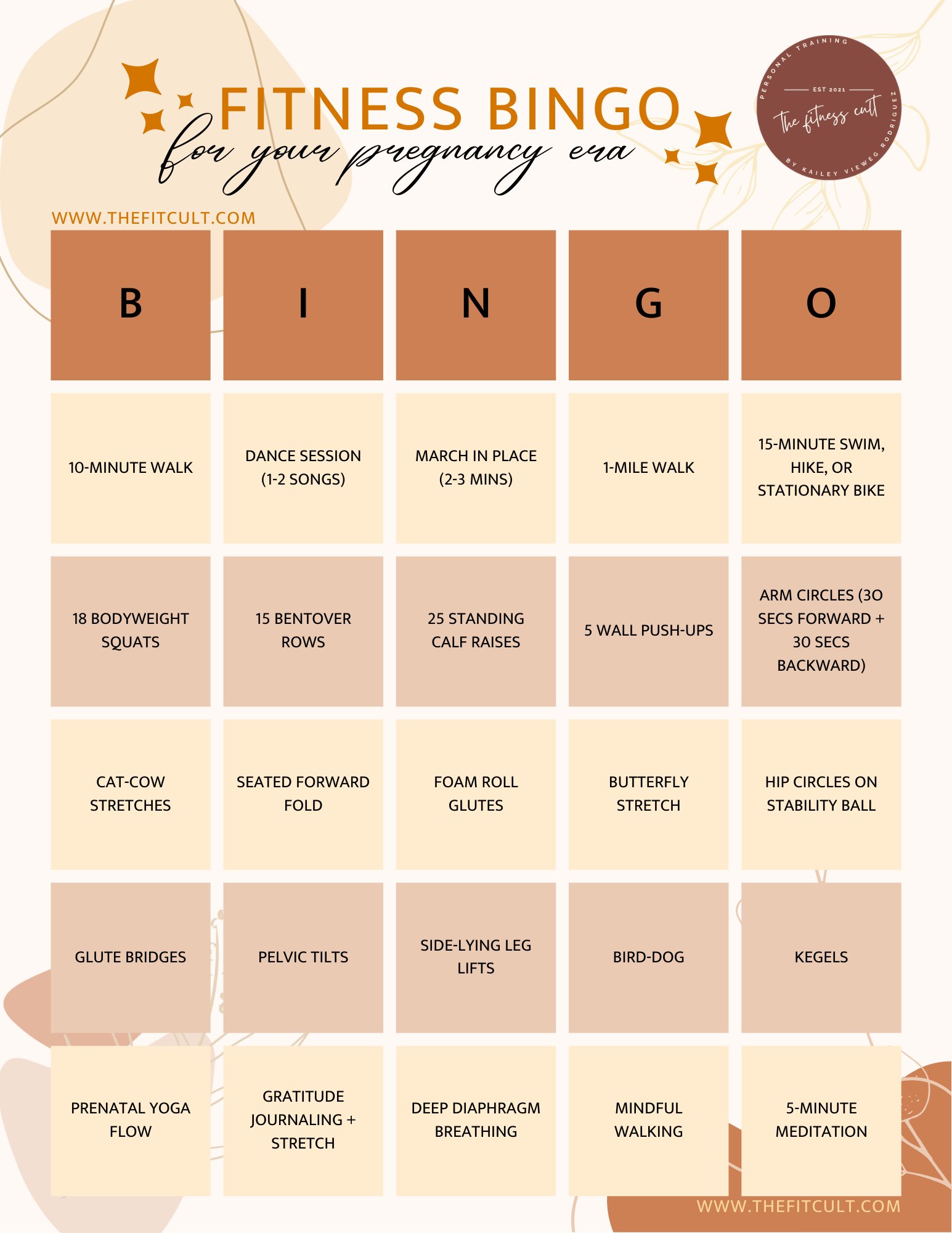
Make movement fun by completing a prenatal fitness bingo card. Include activities like stretching, light strength moves, or a walk. Need ideas? Download my free pregnancy fitness bingo card here and see how many squares you can check off in a month!

Want to take it up a notch? For just $3.99, you can join the Prenatal Fitness Bingo Challenge and unlock a premium version of the card with extra activities, 3 prenatal workouts, and a guided journal, plus a special prize from me when you complete it! It’s a fun way to stay motivated, hold yourself accountable, and celebrate your progress along the way.

5. Crafting a Prenatal Routine

Challenge yourself to build a daily wellness routine that blends movement, rest, and creativity. Use a journal (here is my favorite fitness journal!), app, or calendar to track consistency – because small, steady steps add up to big changes over time.

Building Connections Through Movement

Movement is even more meaningful when it’s shared. Involving your partner, friends, or kids in these challenges adds accountability and joy. Community support is essential during pregnancy, which is why I host programs like:

  • Mommy & Me Fitness Classes – gentle, fun workouts designed for postpartum moms and their babies.
  • Coffee Runs – stroller-friendly runs/walks that end at a local coffee shop (a perfect mix of fitness and connection!).

Safety Considerations

Every pregnancy is unique. Here are a few reminders to keep movement safe:

  • Listen to your body—rest when you need it.
  • Modify intensity and exercises depending on trimester and fitness level.
  • Stay hydrated and avoid overheating.
  • Always check in with your healthcare provider before starting or adjusting your routine.

(If you’re unsure where to start, my post on safe pregnancy exercises offers a detailed breakdown.)

Wrapping It Up

Pregnancy is the perfect time to create habits that support both your health and happiness. Fun challenges like walking goals, yoga practices, dance nights, fitness bingo, and building daily routines can make movement something you look forward to.

Which challenge will you try first? Share your ideas and experiences in the comments—I’d love to hear what’s helping you stay active and connected!

If you’re ready to take the next step in your pregnancy fitness journey, I’d love to support you. Explore my training services, subscribe to the blog for more tips, or send me a message—I’ll help you create a safe, fun, and sustainable plan tailored to your needs!

Leave a Reply

Categories
tfc Community

Build Your Home Gym for Under $500: The Busy Mom’s Guide to Working Out at Home

Disclaimer: As an Amazon Associate, I may earn a commission from qualifying purchases made through my links. Thank you for supporting my work—it helps me keep bringing you tips, resources, and encouragement for your fitness journey!


If you’re a busy mom, you already know the struggle—between school drop-offs, snack prep, laundry, work, and the 17 other things on your daily to-do list, carving out time to get to a traditional gym can feel nearly impossible.

But here’s the good news: you don’t have to go to the gym to get a great workout. With a small investment (under $500!) and a little corner of space in your home, you can set up a home gym that’s perfect for quick, effective workouts—whether you have 10 minutes or a whole hour.

Let’s break down exactly what you’ll need, why it’s worth it, and how these simple pieces of equipment can give you the flexibility to stay consistent and strong without the stress of commute time or childcare.

1. A Good Yoga Mat

First things first—you need a comfortable, supportive surface for your workouts. A yoga mat isn’t just for yoga; it’s your foundation for everything from core workouts to stretching to bodyweight circuits.

Look for one that’s thick enough to protect your knees and wrists but still has a good grip so you won’t slide around during planks or lunges.

This is your “home base” for exercise, and it will make every workout more comfortable and inviting.

This Gruper mat is my favorite and has been my go-to for indoor and outdoor workouts for the last 6 years and is still going strong! It’s thick and cushy without sinking into it and provides a nonslip surface. It’s easy to clean and keep clean, and rolls up for simple storage.

2. Fabric Hip Bands

Next up—fabric hip bands. If you’ve only ever used those thin rubber loop bands that roll and pinch, you’re in for a treat.

Fabric bands are wider, more durable, and way more comfortable. They’re amazing for glute activation, leg workouts, and adding resistance to exercises like squats, hip thrusts, and side steps.

They’re also small and portable, so you can toss one in your diaper bag or suitcase for workouts anywhere.

I love this 6-piece set that includes 3 hip bands and 3 full-body length bands in different levels of resistance. The full-body length bands are great for adding resistance to core moves or incorporating upper body exercises into your band workouts!

3. Rubber Resistance Bands with Handles

Resistance bands with handles are like having a full cable machine… without the giant footprint or price tag.

They’re perfect for upper body workouts, rows, presses, curls, and even some lower body moves. They also make it easy to adjust resistance—just step closer or farther from your anchor point.

If you want a versatile, space-saving tool that can work every muscle in your body, this is it. In fact, if you can only buy ONE item for your home gym, go with these resistance bands! I’ve had my set since pre-COVID times (remember those days?) and use them both for my personal workouts as well as with my clients and they have held up with virtually no wear.

4. Adjustable Dumbbells

Here’s where your strength training game really levels up. Adjustable dumbbells give you multiple weight options in one set, which means you can go lighter for isolation moves or heavier for big compound lifts—all without buying (and storing) a dozen pairs of dumbbells.

They’re also a money-saver long term. Once you have these, you’ll be set for years of progressive strength training.

I like this super versatile set that can be a pair of dumbbells, a Kettlebell, or a barbell and adjust up to 45lb each or 90lb together. This gives you the freedom to explore many types of exercise movements and mix up your workouts!

5. Adjustable Bench

The all-in-one, an adjustable bench. It might seem like a luxury, but it’s actually a total game-changer.

With a bench, you can do incline and flat presses, step-ups, Bulgarian split squats, hip thrusts, and countless other exercises. Adjustable options give you multiple backrest angles, which means more variety in your workouts and more ways to challenge your muscles. I also love that this one has the option for the back extension and support for loads of ab exercises!

6. Adjustable Dumbbell & Equipment Storage Rack

Okay, I’ll be honest—this one might seem “extra,” but it’s actually the secret to keeping your home gym organized and inviting.

A small rack designed to hold your adjustable dumbbells, resistance bands, and other gear not only keeps everything in one place but also makes your workout space feel intentional.

When your equipment is neat and ready to go, you’re more likely to use it (and less likely to trip over it on your way to grab a snack).

Why This Setup Works for Busy Moms

  • No commute — Your gym is just a few steps away.
  • Flexible timing — Workout during nap time, before the kids wake up, or while dinner’s in the oven.
  • Minimal space — All of these items can fit into a small corner of your living room, bedroom, or garage.
  • All-in-one solution — Strength, cardio, flexibility, mobility—it’s all possible with this setup.

Making It Happen

You can find all of these items on Amazon. If you buy them individually, you’ll still come in under $500—and you’ll have everything you need for full-body workouts at home.

Whether you’re squeezing in 15 minutes before the chaos of the day or carving out a longer sweat session, this home gym setup gives you the tools to stay consistent, feel strong, and build the healthy lifestyle you deserve.

Ready to get started?
Click the links to shop, or reach out to me for in-home personal training or virtual coaching—I’ll help you create workouts that fit your equipment, space, and schedule.

Your fitness doesn’t have to wait until “someday.” You can start today, right at home.

← Back

Thank you for your response. ✨

Select all that apply:

Leave a Reply

Categories
Postpartum Strength tfc Community

Family-Friendly Workouts: Staying Active with Your Kids

When I was a kid, my parents used to have us participate in what my mom affectionately deemed “forced family fun times,” where we would all get outside and get moving together. Mostly, we went on bike rides around the neighborhood and to local parks, though I also remember a few 5k Fun Runs and playing soccer or tennis at the park.

Although we all complained at varying times about our “forced family fun,” (teenagers are waaayy too cool for family time, *insert eye roll emoji*), my siblings and I generally had a blast and look back on these memories fondly! We didn’t realize it at the time, but my parents were intentionally carving out time to get us outdoors and moving in the early 2000s home video gaming console boom. I’m sure this helped burn off some of that zealous kid energy, especially on long, summer days of no school, but it also created healthy habits of movement that have lasted through to adulthood.

Getting your kids to join you for your workouts, or doing whatever you can to move together as a family, not only promotes bonding for the whole family, but also instills a love of fitness and lays a solid foundation for lifelong healthy habits for your little ones!

The Importance of Family Workouts

The American College of Sports Medicine (ACSM), recommends that all adults are physically active for a minimum of 30 minutes at least five days a week. This is the target movement amount for typically healthy adults who are looking to maintain general health and muscle mass.

For children, the ACSM recommendations for healthy muscle and bone development are much higher. Children aged 6-17 years old are recommended to have at least 60 minutes of physical activity daily, and children aged 3-5 years old are recommended to engage in active playtime in amounts as tolerated throughout the entirety of their day.

Participating in daily physical activity helps protect against chronic conditions and obesity-related diseases, as well as maintaining sufficient heart and lung health, muscle mass, and bone mineral density. In addition to the clear physical benefits of activity, exercise also has natural mood-boosting and stress-reducing properties due to the hormonal releases that occur with physical activity. Most importantly, perhaps, exercising as a family is a wonderful way to bond and an excellent opportunity to champion your children’s health as well as teach them how to take ownership of their health as they mature.

Fun Workout Ideas for Families

Outdoor Activities

  • local hikes (we love the AllTrails app to find hiking paths and see their difficulty ranking, distance, and other important planning info for families, such as whether the trail is kid-friendly, stroller-friendly, or pet-friendly!)
  • neighborhood walks
  • biking through the neighborhood or at local parks
  • playing tag or hide-and-seek
  • jump rope or hop scotch
  • playing on jungle gyms at local parks

Indoor Activities

  • family dance parties – choreographed or impromptu!
  • “mazes” or “obstacle courses” with household items and furniture
  • building a fort of couch cushions and blankets
  • yoga and stretching

Sports and Games

  • if your kids are involved in local little league or team sports, consider volunteer coaching or reffing their teams to get involved and model an active lifestyle for your kids!
  • play family-friendly sports together, such as soccer, basketball, volleyball, etc
  • create Family Olympics with your kids’ favorite games and sports, or make up your own games to play!

Incorporating Physical Activity into Your Daily Routine

  • walk to school rather than drive (as the weather and distance permits)
  • walk the dog together
  • have family dance parties while doing mundane things such as cooking or folding laundry
  • race from the car to the door
  • balance on one foot while brushing teeth
  • do jumping jacks during commercial breaks when watching TV
    • or, for streaming services: do 5 jumping jacks every time the main character’s name is said

Making Workouts Engaging for Kids

If you are worried about getting your kids on board with your new family workout plan, keep 3 important things in mind: focus on making the workouts fun, keep activities age-appropriate, and get creative with incentives!

Making Workouts Fun

  • ensure activities are age-appropriate, typically catering to the youngest child’s physical capabilities and attention span
  • try team activities and compete kids versus parents
  • keep the mood light – this isn’t about setting a new PR for yourself, it’s about encouraging your kids to enjoy activity!

Suggestions for Age-Appropriate Activities

Plan to cater to the age of your youngest child with age-appropriate activities

Children 3 – 5 years old

  • red light / green light walks or hikes
  • I Spy walks or hikes
  • trips to the local playground
  • indoor play houses (tunnels, ball pits, trampolines, etc)

Children 6 – 10 years old

  • Treasure Hunts with hidden household objects
  • introductory team sports
    • soccer: practice kicking, passing, or defending the goal
    • basketball: practice shooting and dribbling
    • tennis: practice swinging and hitting the ball
    • baseball: practice catching and throwing the ball
  • bike rides
  • three-legged races
  • potato sack races (you can also use oversized pillow cases instead of potato sacks)

Children 10+

  • team sports
  • races and runs (you can use FindARace.com to search for local fun runs to participate in as a team! Or, just race with each other through your local neighborhood or park!)
  • introductory strength training (practicing form on squats, push-ups, planks, etc and moving to light weights when appropriate)

Creative Incentives

  • have small rewards for competitions and team sports
    • small rewards ideas:
      • the family goes out for ice cream
      • kid coupon books
        • “coupons” for your kids like get to skip a chore of your choosing, pick what’s for dinner tonight, get to sleep in, get to pick the movie tonight, etc
  • a “fitness chart” – like a chore chart that can be filled in when activities are completed (daily or weekly) and filled charts can be turned in for a bigger reward
    • bigger reward ideas:
      • the family goes out to dinner
      • get a new sports or exercise-related toy or game (new soccer ball, new baseball glove, hula hoops, jump ropes, etc)
      • new workout clothes or shoes
  • have a Family Olympics Day with gold, silver, and bronze medals (you can get actual medals to use, or something fun like chocolate coins!)

Creating a Family Fitness Plan

When creating a plan around getting your family moving, it’s important to be realistic about what will and won’t work for you as a family. Be sure to take into consideration things like your individual family member’s preferences and energy levels when scheduling a time for your workout. For example, if your kids are always up early with a ton of energy to burn, a post-breakfast hike or games at the park may work well for you! Make it exciting by marking it in a bright color on your calendar, or using stickers to help it stand out as a fun thing to do together.

Get your kids involved in the process by asking them to help you come up with fitness-related goals you can reach together each week. **Please never give children weight loss goals! If your child’s pediatrician has recommended they lose weight, encourage your kids to engage in fun activity and choose healthy foods with the appeal of having plenty of energy to play and grow, rather than focusing on weight loss.**

We recommend instead focusing on what are known as process goals. Process goals are an easily definable goal that focuses on the method or acitivty used to reach your desired outcome, while product goals center on the end result. Good examples of process goals sound like:

  • Play outside 3 times this week
  • Run 3 laps at the park
  • Do 2 family workouts together this week
  • Take a walk together 4 nights after dinner

Once you have clear, achievable process goals, set a time for the workouts and activities and get excited! Remember, your kids will follow your lead on this – if you or your partner/co-parent are annoyed, rather than excited, and completing the family workouts reluctantly and with a grumble or complaint, your kids will adopt the same attitude towards your family workouts, and likely fitness in general. Even if you have to fake it til you make it, try to stay positive and enthusiastic about your family workout time! The more you model healthful behaviors and a positive attitude about sticking to them, they easier it will become to get your kids engaged and excited too.

Combining physical activity with family time to promote fitness and family bonding is such a powerful combination that can leave a lasting impression on your kids for a lifetime! If you’re interested in getting into family workouts but are unsure of how or where to start, let us know and we’d love to help you come up with ideas! Remember to start small and be encouraging and enthusiastic. Look for ways to incorporate activity and healthful behaviors into your daily routines, and celebrate each small win and milestone together! Do you and your family have family workouts? Share your experiences in the comments below!

Leave a Reply