Categories
Postpartum Strength Prenatal Fitness

Building a Support System for Your Fitness Journey as a New Mom

Becoming a mom is life-changing in the best – and sometimes most overwhelming – ways. Between feedings, naps, and adjusting to your new normal, it can feel nearly impossible to carve out time for your own health. If you’ve been wanting to start (or restart) your fitness journey, you’re not alone in feeling like you need more than just willpower – you need support!

A strong support system is the difference between feeling isolated and actually enjoying your postpartum fitness journey. In this post, we’ll explore why support matters, who you can lean on, and how to create a realistic plan that works for your life right now. Stick around to the end for resources and ways to connect with a mom community near you!

Why Support Matters in Postpartum Fitness

Support isn’t just a nice bonus – it’s essential!

  • Mentally and emotionally: Having someone in your corner reduces the sense of being overwhelmed and helps you stay motivated. Accountability keeps you showing up, even on days where it can be hard to get going.
  • Physically: Recovery takes time. Having others encourage rest when needed – or step in so you can take a workout break – makes progress safer and more sustainable.

Why do moms need support with fitness? Because it takes more than physical effort; it takes encouragement, accountability, and the reminder that you’re not doing this alone!

Lean on Your Partner or Family

Your first circle of support is often right at home.

  • Ask for help with baby swaps: One partner watches the baby while the other gets their workout in.
  • Make it a family activity: Try stroller walks, hikes, or dancing in the living room together.
  • Share the load: A partner or family member can help with meal prep or household tasks so you can use that time for movement.

Even extended family or close friends can step in – and are often happy to do so! Try setting up childcare trade-offs – “I’ll watch your little/s tomorrow afternoon if you can watch mine next week!” Support doesn’t have to be fancy; it just has to be intentional.

Join a Mommy & Me Group

Sometimes, you need community beyond your household or immediate tribe. Mommy & Me fitness groups bring connection, movement, and support together in one space.

  • No need to arrange childcare – you bring your baby with you!
  • Surround yourself with other moms who get it.
  • Create social connections while getting your workout in.
  • Bond with your baby through safe, fun activities.

At The Fitness Cult, we offer Mommy & Me classes as well as our local Coffee Run meetups – a fun way to combine movement, community, and a little caffeine!

What are mommy and me fitness classes? They’re group workouts designed for mamas and babies together, making it easier (and more enjoyable!) to stay active.

Create a Realistic Routine

One of the biggest hurdles for new moms is simply finding the time to be active!

Start by setting expectations that fit your current season of life. (For more on this, check out my earlier post How to Set Realistic Fitness Goals During Pregnancy for guidance!

Here are a few ideas to try:

  • Nap workouts: Use short nap windows for a quick strength or mobility session.
  • Stroller or carrier walks: Fresh air + movement + extra resistance of pushing a stroller or carrying a little one with you = win-win-win!
  • Workout with your baby: Try squats or lunges while rocking them to sleep, planks during tummy time, or gentle yoga while they explore nearby.

How to find time to work out as a new mom? By weaving fitness into the flow of your daily routine instead of forcing long, rigid sessions. Remember, a little bit of anything is still more than a whole lotta nothin’!

Additional Support Strategies

Sometimes, it takes a little extra accountability and structure.

  1. Find an Accountability Buddy
    • Team up with a friend, another mom, or even a virtual partner! Daily texts or weekly calls and Facetimes can be enough to keep each other motivated.
  2. Leverage Online Communities and Resources
    • Whether it’s a private Facebook group, a local community board, or an online coaching program, digital spaces can offer 24/7 encouragement. My newsletter is a great place to start if you want regular postpartum-friendly fitness tips straight to your inbox!
  3. Work with a Postpartum-Specialized Trainer
    • A certified pre/postnatal trainer understands your unique needs and ensures your workouts are safe and effective. This level of support helps you avoid injury and progress with confidence. (If you’re looking for one-on-one guidance, I’d love to help – let’s chat!)

Putting It All Together

You don’t need to build the “perfect” support system overnight. Start small. Maybe that looks like asking your partner to take over bedtime once a week to get your movement in, or signing up for just one community class to get started.

Even one support pillar – partner, family, group, or buddy – can make all the difference. The important thing is that you don’t have to do this alone!

Ready for Your Next Step?

Your postpartum fitness journey should feel supported, not stressful.

Subscribe today to get exclusive postpartum fitness tips, realistic routines, and community resources sent right to your inbox.
☕ Or, if you’re local, join us for a Coffee Run meetup or try one of our Mommy & Me classes—we’d love to meet you and your little one!

And if you know another mom who could use some encouragement? Share this post with her—you never know whose day you’ll brighten!

Leave a Reply

Categories
Prenatal Fitness tfc Community

Fun Pregnancy Challenges: Encouraging Movement and Connection

Pregnancy is a season of transformation – your body is working harder than ever, and staying active can help you feel stronger, healthier, and more connected throughout the journey. Movement during pregnancy isn’t about pushing your limits; it’s about supporting your well-being, preparing for postpartum recovery, and embracing the joy that comes from staying active.

One of the most engaging ways to keep moving is by turning fitness into a game; pregnancy challenges. These fun, upbeat activities help you stay motivated while strengthening connections with your partner, friends, or other moms-to-be.

Why Movement Matters During Pregnancy

Staying active while pregnant offers both physical and emotional benefitsL

  • Improved circulation and reduced aches and pains – Movement helps with common discomforts like swollen ankles, back pain, and stiffness.
  • Boosted emotional well-being – Gentle activity lowers stress, improves mood, and helps reduce pregnancy-related anxiety.
  • Postpartum readiness – A consistent fitness routine during pregnancy creates a smoother recovery and helps rebuild strength after delivery.

(If you’re curious about specific exercises and safety tips, check out my post Safe Exercises for Each Trimester of Pregnancy and The Importance of Core Strength During Pregnancy.)

Fun Pregnancy Challenge Ideas

Here are some creative, approachable ways to add movement to your pregnancy:

1. Daily Walks Challenge

Set a goal for daily steps or distance – tailor it to your fitness level! Unsure where to start:

  • Just starting out: 5,000 – 6,000 steps (2 – 3 miles)
  • Turn up the challenge: 7,000 – 8,000 steps (3.5 – 4 miles)
  • Bring the heat: 9,000 – 10,000+ steps (4 – 5+ miles)

Invite your partner or a friend to join you for accountability. Share your progress on social media and tag me @the_fitnesscult with #thefitnesscult so I can cheer you on!

2. Prenatal Yoga Challenge

Yoga is wonderful for flexibility, relaxation, and core stability. Try a 30-day yoga challenge, featuring one prenatal-friendly pose each day. This not only eases tension but also creates a calming daily ritual.

(I recently wrote about how yoga and gentle exercise support pregnancy in my post The Benefits of Prenatal Yoga for Moms-to-Be – it’s a great place to start if you’re new to yoga!)

3. Partner Dance Challenge

Dancing with your partner is a fun way to bond and stay active! Experiment with different styles – salsa, ballroom, or even just swaying in your living room. Take a class together, go to a dance club or live music event, or create a playlist of songs that make you smile and get your groove on together a few times a week.

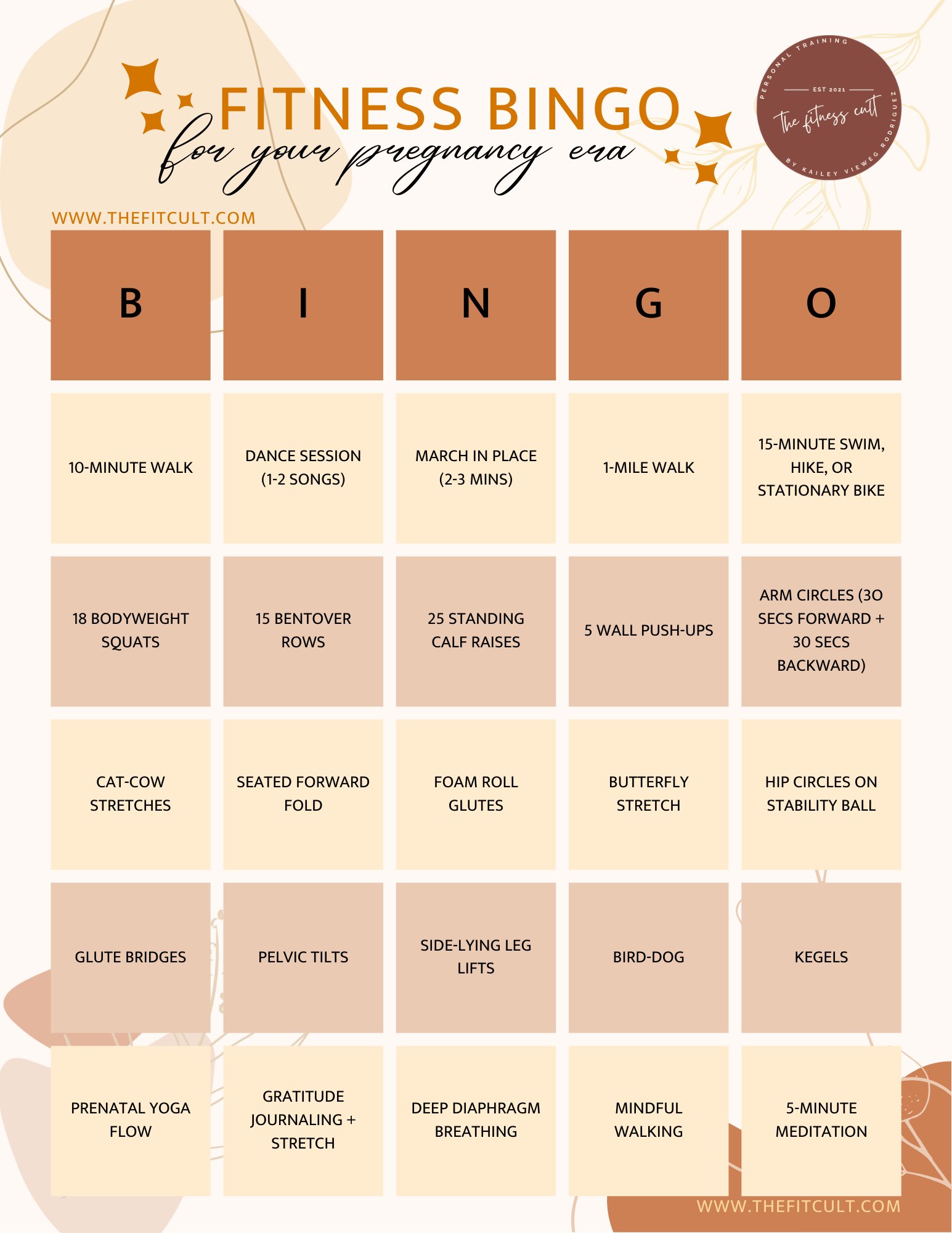
4. Fitness Bingo

Make movement fun by completing a prenatal fitness bingo card. Include activities like stretching, light strength moves, or a walk. Need ideas? Download my free pregnancy fitness bingo card here and see how many squares you can check off in a month!

Want to take it up a notch? For just $3.99, you can join the Prenatal Fitness Bingo Challenge and unlock a premium version of the card with extra activities, 3 prenatal workouts, and a guided journal, plus a special prize from me when you complete it! It’s a fun way to stay motivated, hold yourself accountable, and celebrate your progress along the way.

5. Crafting a Prenatal Routine

Challenge yourself to build a daily wellness routine that blends movement, rest, and creativity. Use a journal (here is my favorite fitness journal!), app, or calendar to track consistency – because small, steady steps add up to big changes over time.

Building Connections Through Movement

Movement is even more meaningful when it’s shared. Involving your partner, friends, or kids in these challenges adds accountability and joy. Community support is essential during pregnancy, which is why I host programs like:

  • Mommy & Me Fitness Classes – gentle, fun workouts designed for postpartum moms and their babies.
  • Coffee Runs – stroller-friendly runs/walks that end at a local coffee shop (a perfect mix of fitness and connection!).

Safety Considerations

Every pregnancy is unique. Here are a few reminders to keep movement safe:

  • Listen to your body—rest when you need it.
  • Modify intensity and exercises depending on trimester and fitness level.
  • Stay hydrated and avoid overheating.
  • Always check in with your healthcare provider before starting or adjusting your routine.

(If you’re unsure where to start, my post on safe pregnancy exercises offers a detailed breakdown.)

Wrapping It Up

Pregnancy is the perfect time to create habits that support both your health and happiness. Fun challenges like walking goals, yoga practices, dance nights, fitness bingo, and building daily routines can make movement something you look forward to.

Which challenge will you try first? Share your ideas and experiences in the comments—I’d love to hear what’s helping you stay active and connected!

If you’re ready to take the next step in your pregnancy fitness journey, I’d love to support you. Explore my training services, subscribe to the blog for more tips, or send me a message—I’ll help you create a safe, fun, and sustainable plan tailored to your needs!

Leave a Reply

Categories
tfc Community

Build Your Home Gym for Under $500: The Busy Mom’s Guide to Working Out at Home

Disclaimer: As an Amazon Associate, I may earn a commission from qualifying purchases made through my links. Thank you for supporting my work—it helps me keep bringing you tips, resources, and encouragement for your fitness journey!


If you’re a busy mom, you already know the struggle—between school drop-offs, snack prep, laundry, work, and the 17 other things on your daily to-do list, carving out time to get to a traditional gym can feel nearly impossible.

But here’s the good news: you don’t have to go to the gym to get a great workout. With a small investment (under $500!) and a little corner of space in your home, you can set up a home gym that’s perfect for quick, effective workouts—whether you have 10 minutes or a whole hour.

Let’s break down exactly what you’ll need, why it’s worth it, and how these simple pieces of equipment can give you the flexibility to stay consistent and strong without the stress of commute time or childcare.

1. A Good Yoga Mat

First things first—you need a comfortable, supportive surface for your workouts. A yoga mat isn’t just for yoga; it’s your foundation for everything from core workouts to stretching to bodyweight circuits.

Look for one that’s thick enough to protect your knees and wrists but still has a good grip so you won’t slide around during planks or lunges.

This is your “home base” for exercise, and it will make every workout more comfortable and inviting.

This Gruper mat is my favorite and has been my go-to for indoor and outdoor workouts for the last 6 years and is still going strong! It’s thick and cushy without sinking into it and provides a nonslip surface. It’s easy to clean and keep clean, and rolls up for simple storage.

2. Fabric Hip Bands

Next up—fabric hip bands. If you’ve only ever used those thin rubber loop bands that roll and pinch, you’re in for a treat.

Fabric bands are wider, more durable, and way more comfortable. They’re amazing for glute activation, leg workouts, and adding resistance to exercises like squats, hip thrusts, and side steps.

They’re also small and portable, so you can toss one in your diaper bag or suitcase for workouts anywhere.

I love this 6-piece set that includes 3 hip bands and 3 full-body length bands in different levels of resistance. The full-body length bands are great for adding resistance to core moves or incorporating upper body exercises into your band workouts!

3. Rubber Resistance Bands with Handles

Resistance bands with handles are like having a full cable machine… without the giant footprint or price tag.

They’re perfect for upper body workouts, rows, presses, curls, and even some lower body moves. They also make it easy to adjust resistance—just step closer or farther from your anchor point.

If you want a versatile, space-saving tool that can work every muscle in your body, this is it. In fact, if you can only buy ONE item for your home gym, go with these resistance bands! I’ve had my set since pre-COVID times (remember those days?) and use them both for my personal workouts as well as with my clients and they have held up with virtually no wear.

4. Adjustable Dumbbells

Here’s where your strength training game really levels up. Adjustable dumbbells give you multiple weight options in one set, which means you can go lighter for isolation moves or heavier for big compound lifts—all without buying (and storing) a dozen pairs of dumbbells.

They’re also a money-saver long term. Once you have these, you’ll be set for years of progressive strength training.

I like this super versatile set that can be a pair of dumbbells, a Kettlebell, or a barbell and adjust up to 45lb each or 90lb together. This gives you the freedom to explore many types of exercise movements and mix up your workouts!

5. Adjustable Bench

The all-in-one, an adjustable bench. It might seem like a luxury, but it’s actually a total game-changer.

With a bench, you can do incline and flat presses, step-ups, Bulgarian split squats, hip thrusts, and countless other exercises. Adjustable options give you multiple backrest angles, which means more variety in your workouts and more ways to challenge your muscles. I also love that this one has the option for the back extension and support for loads of ab exercises!

6. Adjustable Dumbbell & Equipment Storage Rack

Okay, I’ll be honest—this one might seem “extra,” but it’s actually the secret to keeping your home gym organized and inviting.

A small rack designed to hold your adjustable dumbbells, resistance bands, and other gear not only keeps everything in one place but also makes your workout space feel intentional.

When your equipment is neat and ready to go, you’re more likely to use it (and less likely to trip over it on your way to grab a snack).

Why This Setup Works for Busy Moms

  • No commute — Your gym is just a few steps away.
  • Flexible timing — Workout during nap time, before the kids wake up, or while dinner’s in the oven.
  • Minimal space — All of these items can fit into a small corner of your living room, bedroom, or garage.
  • All-in-one solution — Strength, cardio, flexibility, mobility—it’s all possible with this setup.

Making It Happen

You can find all of these items on Amazon. If you buy them individually, you’ll still come in under $500—and you’ll have everything you need for full-body workouts at home.

Whether you’re squeezing in 15 minutes before the chaos of the day or carving out a longer sweat session, this home gym setup gives you the tools to stay consistent, feel strong, and build the healthy lifestyle you deserve.

Ready to get started?
Click the links to shop, or reach out to me for in-home personal training or virtual coaching—I’ll help you create workouts that fit your equipment, space, and schedule.

Your fitness doesn’t have to wait until “someday.” You can start today, right at home.

← Back

Thank you for your response. ✨

Select all that apply:

Leave a Reply

Categories
Postpartum Strength Prenatal Fitness

5 Pelvic Floor Exercises That Are Not Kegels

5 Pelvic Floor Exercises That Are Not Kegels

If you’ve ever experienced pregnancy or childbirth, you know firsthand the importance of pelvic floor strength, and how difficult it can be when those muscles have been compromised (if you cross your legs when you sneeze, or jumping jacks send you running to the bathroom, you know what I’m talking about!). So why does this happen?

First, let’s talk about what the pelvic floor is and what that really means. The pelvic floor is a group of muscles that are part of our larger core muscle group. We tend to think about our “core” as just our abs, or “6-pack muscles;” but the core is actually made up of our abdominal wall, oblique abdominals, transverse abdominis, erector spinae, supporting and stabilizing muscles of the chest and back, hip flexors, glutes, diaphragm, and, of course, the pelvic floor. The pelvic floor muscles span from one side of the pelvis to the other and act as a “net” to support the pelvic organs, such as the bladder, vagina, anus, and uterus.

In pregnancy, the growing baby and uterus stretch and push the muscles of the abdominal wall and pelvic floor, and the pelvic floor supports the added weight throughout the pregnancy.

Kegels are an exercise that targets the pelvic floor muscles, particularly around the urethra, through contracting, or tightening, the muscles. While performing kegels is undoubtedly an essential part of maintaining the strength of the pelvic floor, if this is all you are doing, you likely do not feel the strength returning to the desired level.

It’s important to diversify your pelvic floor workouts to include the entire muscle group of the pelvic floor muscles, as well as working to integrate and strengthen the surrounding muscles of the hip complex and glutes. Intentionally strengthening the entire “net” of pelvic floor muscles and their surrounding joints and neighboring muscles will provide a stronger foundation and better support your internal pelvic organs.

Disclaimer: Before starting any new exercise routine, it is essential to consult with your healthcare provider or medical care team, particularly if you have any existing health concerns or conditions. This blog post is intended for informational purposes only and is not a substitute for professional medical advice. Always prioritize your health and safety by seeking guidance tailored to your individual needs.

1. Glute Bridge

The glute bridge exercise is performed while lying on your back and by lifting your hips in an upward motion. The glutes, hips, low back, and pelvic floor are all engaged during this movement.

Start by lying on your back with your knees bent and feet planted on the floor. Begin squeezing through the glutes, exhale, and lift the hips off the ground as high into the air as you can, while continuing to contract the glute muscles. Relax the muscles and inhale as you return the hips to the starting position on the floor. You can make this move more challenging by holding for a few seconds at the top, continuing to engage the glute muscles and breathing normally.

The glute bridge strengthens the pelvic floor muscles, along with the glutes, hips, and core; adding to overall stability as well as pelvic floor strengthening.

2. Squats

Squats represent one of 3 lower body functional movements (bending) used throughout our daily activity – such as sitting down and standing back up. They engage the lower body muscles, as well as the core, glutes, hips, and pelvic floor.

Start standing with feet slightly wider than hip-distance. Inhale as you hinge forward at the hips, sending the glutes backwards behind you, and continue motion downward by bending through the knees. When you have lowered as much as you can without pain or losing control of the motion, exhale as you press through both feet firmly and squeeze through the glutes to return to the starting position of standing.

Squats strengthen the muscles that support and hold up the pelvic floor (hamstrings, glutes, and hips), as well as strengthening the pelvic floor muscles through proper engagement of the core.

3. Dead Bug

The dead bug movement engages the core muscles, including the pelvic floor, while working to stabilize the body throughout a coordinated movement.

Start by laying on your back with your arms and legs in the air above you (i.e., looking like a dead bug on its back, hence the name!). Arms should be straight and positioned directly above the shoulders; legs should be bent to a 90 degree angle with the knees positioned directly above the hips and the feet extended outward, away from the body. Inhale and reach the right arm overhead to touch the floor above your head, while extending the left leg straight through the knee to touch your foot to the floor in front of you. Exhale as you return arm and leg to their starting positons over your body, then repeat with the left arm and right leg.

The dead bug exercise strengthens the pelvic floor muscles by engaging the deep core muscles that support the pelvis and spine. This exercise is particularly effective for strengthening the transverse abdominis, which is a key muscle for pelvic stability and pelvic floor support.

4. Bird Dog

The bird dog exercise engages the core muscles, including the pelvic floor, while working to stabilize the body throughout a coordinated movement.

Start in a tabletop position on your hands and knees, with hands positioned directly under the shoulders and knees positioned directly under the hips. Draw the belly button toward the spine to engage the core, then inhale and extend the right arm straight in front of you at shoulder height, while also extending the left leg directly behind you at hip height. Exhale and create a crunching movement through the abdomen, drawing the right elbow toward the left knee, then return to the starting tabletop position.

The bird dog exercise strengthens pelvic floor muscles by engaging the core, including the abdominal muscles and pelvic floor, which are crucial for supporting the spine and maintaining stability. By challenging the core and balance while moving your limbs, the bird dog exercise helps improve core stability and indirectly strengthens the pelvic floor.

5. Clamshells

The clamshell exercise engages the hip complex, the glutes, the stabilizing muscles of the core, and the pelvic floor. This movement is performed lying on your side and targets one side of the body at a time.

Start by lying on your left side with your knees slightly bent and stacked, your feet in line with your spine and stacked. Firmly press your heels together and exhale while lifting the right knee upwards, opening through the hips as wide as you can without pain. Inhale as you relax through the hips and glutes and return to the starting position of knees touching. Repeat on each side.

The clamshell exercise primarily strengthens hip muscles that work in synergy with the pelvic floor. By strengthening these surrounding muscles, the clamshell exercise can contribute to the overall stability and strength of the pelvic floor, which can indirectly benefit pelvic floor health and function.

In a nutshell, taking care of your pelvic floor is super important for a strong core and overall health. Mixing in exercises like glute bridges, squats, dead bugs, and bird dogs can really help strengthen those muscles. If you’re interested in boosting your pelvic floor strength and just feeling better overall, don’t hesitate to reach out! We’d love to chat and see how we can help you on your fitness journey!

Have you tried any of these pelvic floor exercises? Let us know either way in the comments!

Leave a Reply